
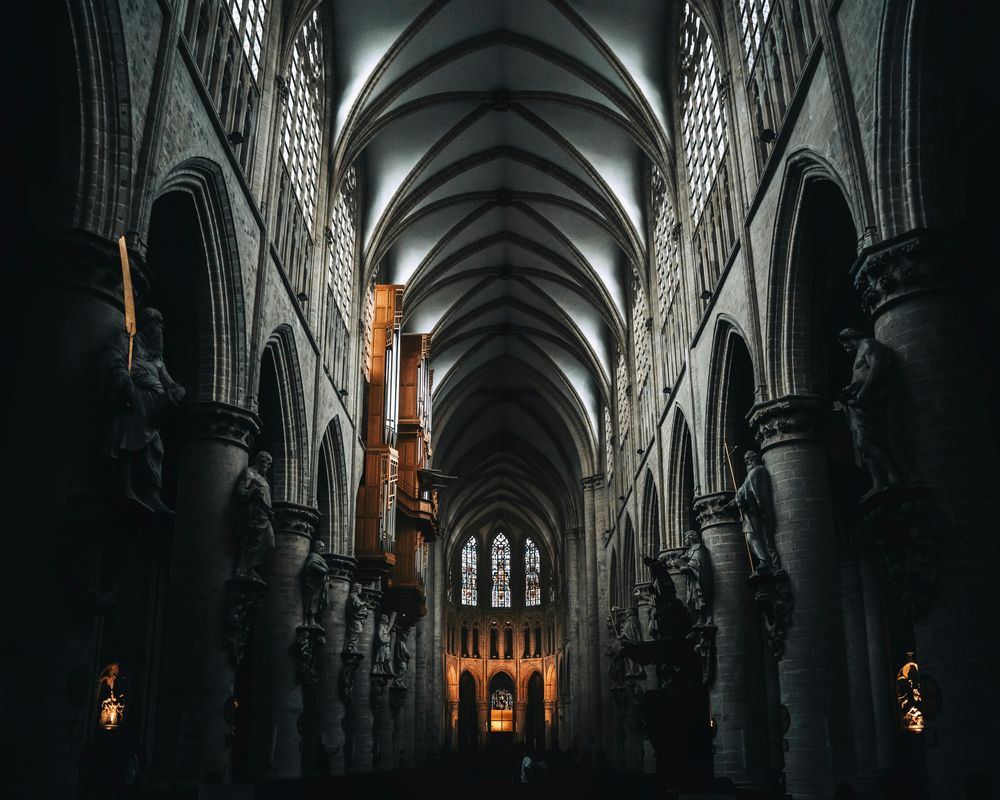
 Churches and mosques are places of assembly where speech and music play a central role. However, their architectural characteristics generally pose a considerable acoustic challenge. The vast majority of religious buildings are large, with wide naves and high ceilings that prolong reverberation; they are constructed with reflective materials such as stone, marble or mosaic, which return the sound without absorbing it, and their space is filled with columns, annexes and complex layouts that require covering very different areas with a single system.
An effective public address system must adapt to the diversity of spaces found in these buildings: the main nave, presbytery or mihrab, sacristy, side chapels, choir, crypt, cloister, bell tower, offices, community halls... In mosques, in addition to the prayer hall and the mihrab, there are equivalent spaces such as ablution rooms, outdoor courtyards and minarets. It must be ensured that every worshipper, in any corner of the building, can clearly hear the liturgy or the prayer.
Reverberation
It is the acoustic effect that normally worsens intelligibility in this type of building. Reverberation is the persistence of sound in an enclosure after the emitting source has stopped, caused by multiple reflections on hard surfaces. It is measured by the reverberation time (T60), which indicates how long it takes for the sound to decrease by 60 dB once the emission has ceased. Short T60 values favour speech intelligibility, and long T60 values enrich music, but we are talking about values below 1.5 seconds for speech and below 4 seconds for music: Cologne Cathedral, for example, has a reverberation time of almost 13 seconds, and most cathedrals are between 8 and 12 seconds. These values are due to the large volumes, with very high ceilings, reflective materials, absence of absorption, and complex geometry.
The effect of an excessively long reverberation time on speech is the overlapping of syllables and a drastic reduction in intelligibility. For music, a certain level of reverberation can enrich choral or organ singing, but if it is excessive, definition is lost and harmonic confusion is generated.
Acoustic and Electroacoustic Solutions
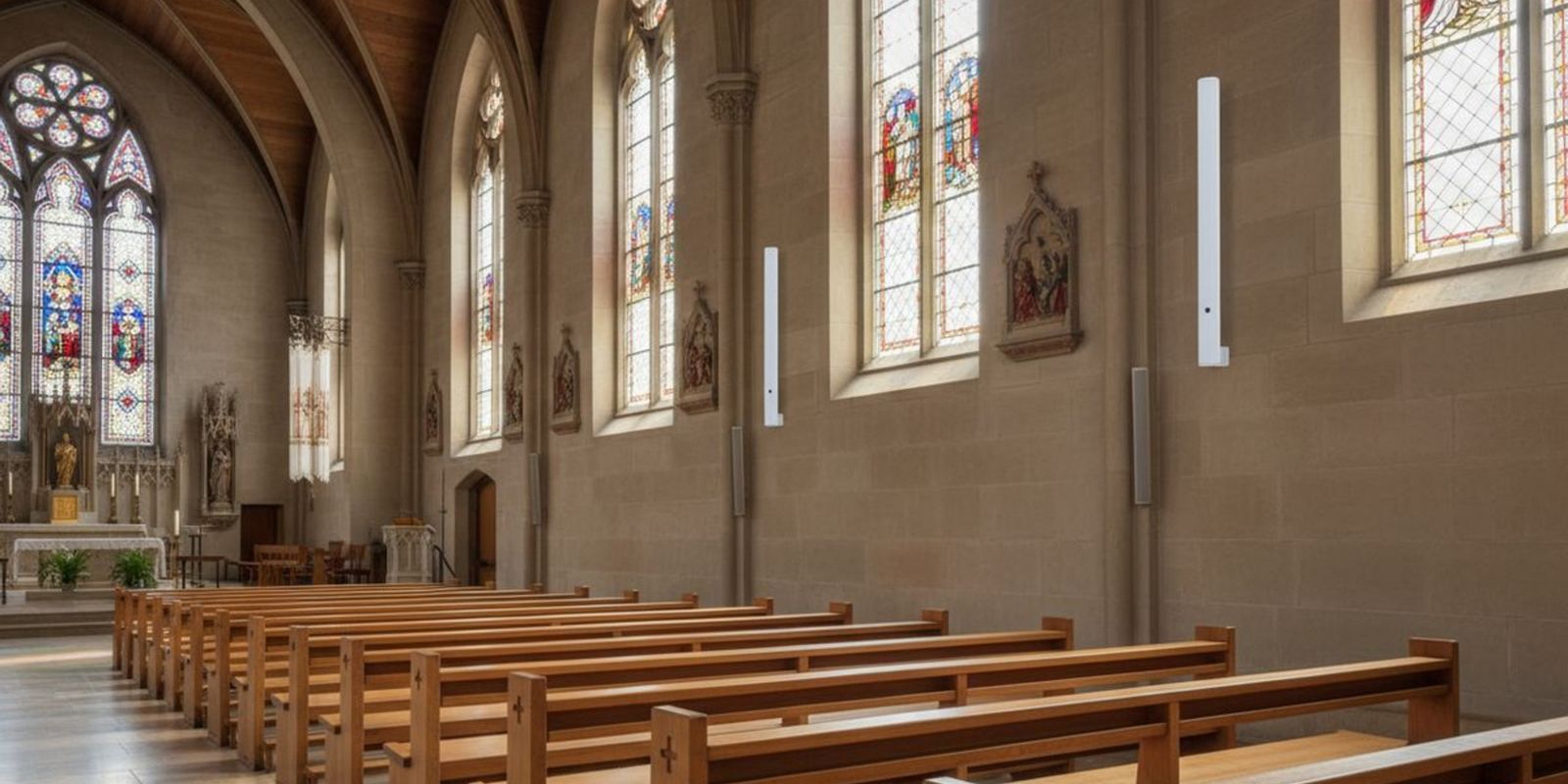 To improve intelligibility in these spaces there are many solutions, both acoustic and electroacoustic. The former are passive and aim to increase absorption through treatments, furniture, coverings, carpets or curtains. The electroacoustic solutions amplify the sound while avoiding reflections, using acoustic columns that reduce vertical dispersion and widen the horizontal, digital processors (DSP) to apply equalisation, delays and filters, distributed reinforcement systems with additional loudspeakers synchronised in chapels, crypts or cloisters, and exponential loudspeakers outdoors, usually in bell towers to reproduce the sound of the bells or in minarets to broadcast the call to prayer.
Microphones and Acoustic Feedback Control
In most celebrations, directional microphones are used to capture the voice of the officiant or imam, usually with a flexible, adjustable gooseneck, reducing ambient noise pickup. Wireless microphones are also common, being flexible and less intrusive in these buildings by avoiding cables. In any case, even with suitable microphones, acoustic feedback (coupling or “Larsen effect”) can occur when amplified sound re-enters the microphone and creates a loop that produces a shrill whistle. Any modern system can incorporate anti-Larsen filters in digital audio processing, automatic equalization to attenuate critical frequencies, and proper gain and delay management to maintain sound levels without feedback risk. This signal processing is essential in highly reverberant spaces, such as a large cathedral or mosque, where the risk of feedback is greater.
Applicable Regulations
Places of worship are public buildings. In addition to the audio system for liturgy, when capacity exceeds 500 people (in cathedrals, basilicas, large mosques...) a public address system is required to guide people in case of evacuation, which may use the same loudspeakers or others specific for voice alarm. As it is integrated with the fire safety system, the installed equipment must comply with European standard EN 54, specifically section 16 for voice alarm control and indicating equipment, section 24 for loudspeakers, and section 4 for monitored power supplies. If capacity is lower, but there is a voice evacuation system connected to the fire safety system, it must also comply with EN 54.