
In a public address, voice alarm, or intercom system, the physical robustness of the installed devices is a determining factor in their operational lifespan. While central equipment operates in protected control rooms, loudspeakers and intercoms are field devices exposed to atmospheric conditions and, particularly, to acts of vandalism, intense vibrations, or accidental mechanical impacts. To evaluate this resistance against external physical aggression, the IK protection rating is used.
What is the IK Protection Rating?
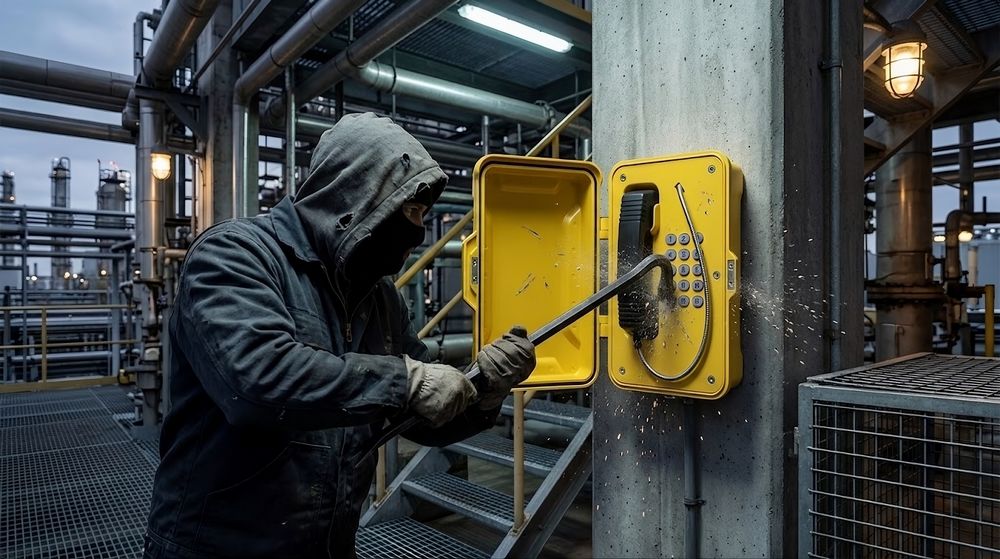 Promotional image in a simulated environmentThe IK code is an international numerical-normative classification indicating the capacity of an electrical or electronic equipment enclosure to protect its internal components against external mechanical impacts.
This classification is standardized by the European standard EN 62262 (equivalent to international standard IEC 62262). Its objective is to provide a uniform standard so that engineers, designers, and integrators can objectively audit the level of robustness or vandal resistance of a device.
The nomenclature consists of the letters IK followed by a two-digit number (from IK00 to IK10). The higher the number, the greater the impact energy the equipment can withstand without compromising its physical integrity or correct technical operation.
How is the IK Protection Rating Certified?
To assign and certify a specific IK rating, standard EN 62262 strictly defines the test methodology to which the equipment enclosure must be subjected. During laboratory testing, the device is installed in its normal mounting conditions and receives a series of controlled impacts at its most vulnerable points (front panels, pushbuttons, grilles, or display windows).
Tests are performed using various standardized types of hammers (pendulum hammer, spring hammer, or free-fall hammer). Each IK level specifies three fundamental variables:
- Impact energy (measured in Joules - J): Indicates the force exerted on the equipment.
- Mass and material of the striking element: Ranges from polyamide pieces to steel masses weighing several kilograms.
- Drop distance or height: Determines the velocity and acceleration at the moment of collision.
IK Code Correspondence Table (EN 62262)
Below are the 11 levels defined by the standard, detailing the supported energy and its practical equivalence to everyday impacts:
| IK Code | Impact Energy (J) | Test Equivalence (Free Fall) | Protection Level / Application |
| IK00 | No protection | No test | Exclusive use in risk-free indoor areas. |
| IK01 to IK05 | 0.14 J to 0.70 J | Drop of 200g to 350g masses from 7.5cm to 20cm | Protection against light contact or minor handling. |
| IK06 | 1.00 J | 500 g mass falling from 20 cm | Light manual impacts without tools. |
| IK07 | 2.00 J | 500 g mass falling from 40 cm | Moderate accidental impacts. |
| IK08 | 5.00 J | 1.7 kg mass falling from 30 cm | Standard vandal resistance: Withstands direct punches or kicks. |
| IK09 | 10.00 J | 5.0 kg mass falling from 20 cm | High vandal resistance: Withstands severe impacts from thrown objects. |
| IK10 | 20.00 J | 5.0 kg mass falling from 40 cm | Maximum vandal/industrial resistance: Withstands deliberate blows with hammers or iron bars. |
Technical Nuance: Intercoms vs. Loudspeakers
When drafting technical specifications for a project, the demand for the IK rating varies substantially depending on the type of field equipment:
 Promotional image in a simulated environment
Intercoms: The Critical Requirement for IK
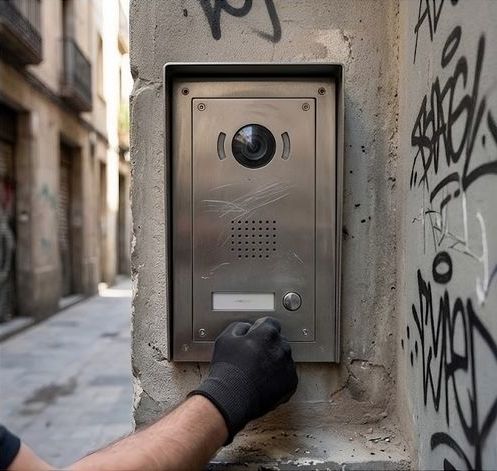
Intercom stations are typically installed at hand height (toll plazas, building entrances, parking lots, prisons, bus stops, industrial environments, or stadiums). Being interactive elements directly within reach of users and passersby, they face a high risk of vandalism, destructive abuse, or accidental impacts from vehicles and machinery.
In this context, specifying IK08, IK09, or IK10 levels is essential to guarantee service availability. Stainless steel or cast aluminum alloy chasses, alongside embedded metal buttons and high-density polycarbonate display windows, are characteristic features of IK10 intercoms.
 Promotional image in a simulated environment
Loudspeakers: Why Don't They Usually Declare an IK Code?
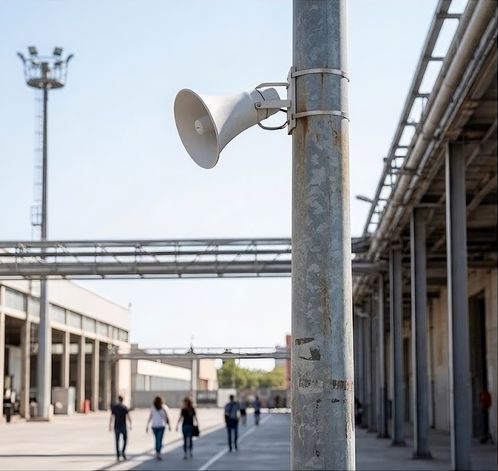
In public address and voice alarm systems, the vast majority of ceiling speakers, sound projectors, or horn loudspeakers do not publish an IK code on their commercial datasheets. This does not mean they are fragile; rather, their typical location is on ceilings, poles, or elevated structures out of human reach, where the risk of direct mechanical impact is virtually non-existent.
The Exception: ATEX-Certified Loudspeakers
The EN 60079-0 testing standard requires ATEX enclosures to undergo rigorous mechanical shock tests (typically 7 Joule impact tests). Therefore, even if an ATEX horn loudspeaker is not marketed with an IK mark printed on it, its certification tests implicitly guarantee a structural resistance equivalent to IK08 or IK09 levels.
The IK Rating Does Not Act Alone
A device with a stainless steel enclosure certified to IK10 may be completely immune to hammer blows, but it will be useless if rain penetrates its circuitry or if flammable ambient gases cause an ignition.
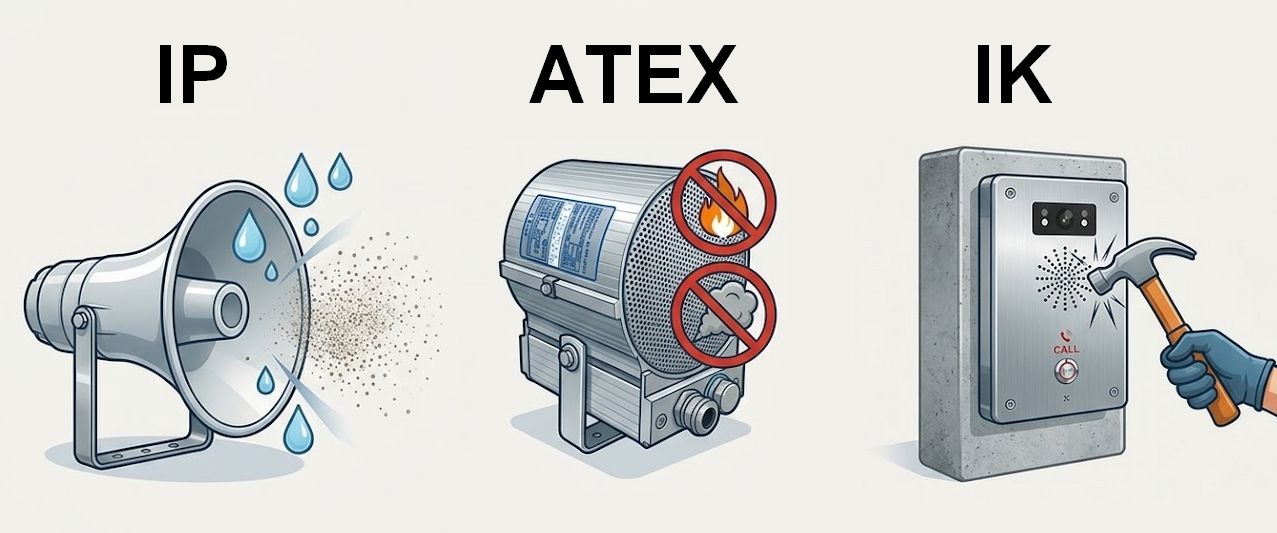
Therefore, designing and selecting field equipment for demanding projects requires evaluating other types of physical protections; the most common being the IP rating and ATEX certification alongside the IK rating.
- IP Rating (EN 60529): To guarantee ingress protection against water and dust.
- IK Rating (EN 62262): To ensure structural survival against impacts or vandalism.
- ATEX Certification (EN 60079): To prevent explosions in areas with combustible gases or dusts.
Intercom and Public Address Solutions at OPTIMUS
At OPTIMUS, we offer a comprehensive range of technology solutions tailored to the strictest mechanical durability requirements:
- High-resistance intercom stations: We offer product ranges reaching from IK08 (such as AIPHONE's IX series) and IK09 (CASTEL series) up to the maximum robustness rating of IK10 found in FANVIL models and especially in the range from specialist J&R (many of which also combine IP67, protective metal door options, and ATEX certification).
- Industrial public address: Many loudspeakers are made from weather-resistant materials and feature robust construction, while specialized solutions from manufacturer DNH include ATEX-certified models with high mechanical resistance (implicitly IK08/IK09) and thermal performance.
Conclusion: The Environment Determines the Equipment
Selecting the right equipment is not about seeking the highest IK number in every situation, but rather accurately assessing the risks of the installation environment. An efficient design balances investment by ensuring that every loudspeaker or intercom delivers absolute technical reliability throughout its lifespan.