
The installation of accessible bathrooms and changing rooms in public and private spaces responds to a regulatory requirement, but it also stems from a growing social awareness: building environments that are accessible to everyone—primarily for people with disabilities, but also to improve safety and autonomy for all users. A fracture, a temporary illness, aging, or even pregnancy can turn anyone into a potential user of an adapted space. That’s why designing with accessibility criteria means committing to inclusion, prevention, and universal comfort.
Regulatory and technical requirements
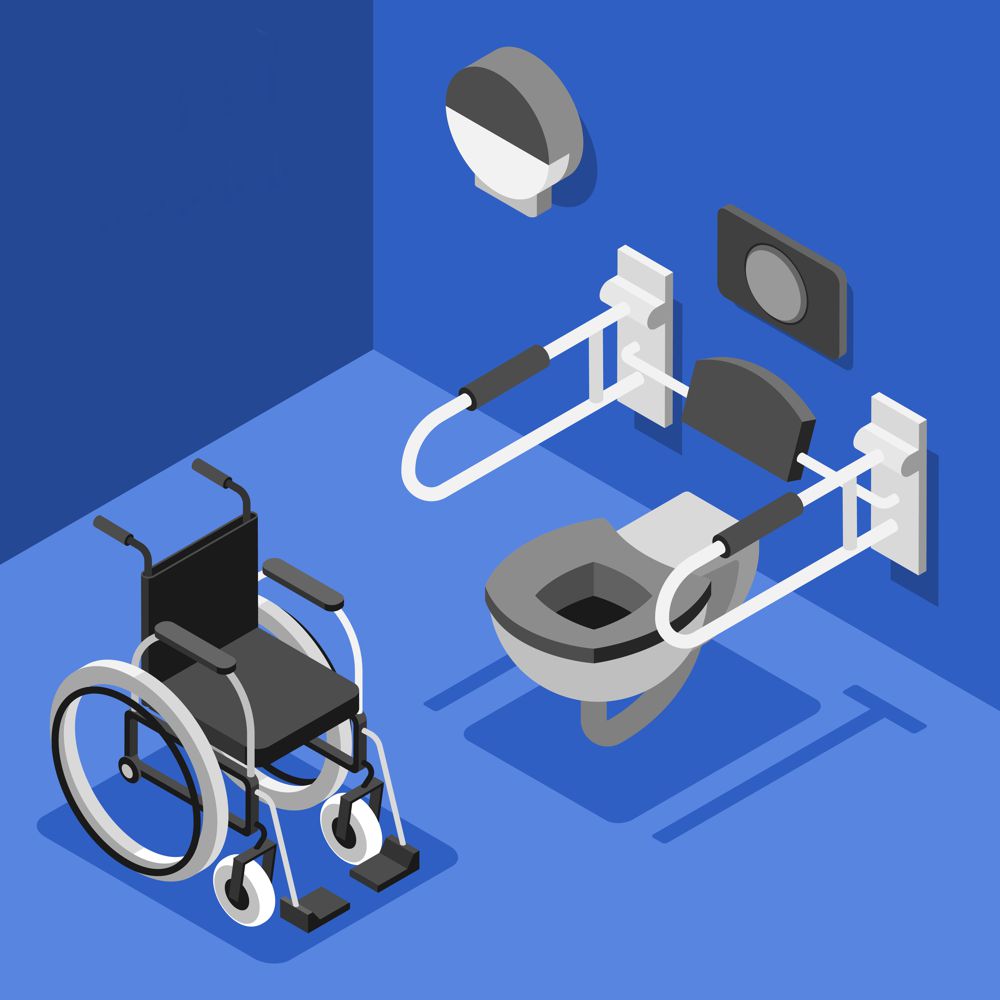 The Spanish Technical Building Code (CTE), in its Basic Document SUA 3 on safety against entrapment risk, states that accessible bathrooms and changing cabins must include an assistance call system that is perceptible from a control point or a frequently used passageway. This requirement applies to new construction of public, healthcare, educational, commercial, and other collective-use buildings, as well as to major renovations or changes of use that affect the layout or accessibility conditions of the bathroom. It also extends to refurbishments involving key bathroom elements—such as installations, layout, or finishes—whenever such actions may compromise or improve the space’s accessibility.
The system must allow the user to verify that their call has been received and must emit the signal simultaneously via visual and acoustic means. It must also be operable from the toilet, from designated seating for changing or showering, and from the floor—anywhere within the transfer zone. ISO 21542 recommends that the call device be a red pull cord with two activation elements—such as balls or bracelets of 50 mm diameter—placed at two heights: one between 800 and 1100 mm, and another at 100 mm from the floor. The regulation also specifies audibility conditions—with levels above 65 dB but below 118 dB, and at least 15 dB above ambient noise—and visibility requirements, with adequate contrast and sufficient intensity without causing glare.
Regarding the call tone level, 15 dB is the international recommendation to ensure it is clearly perceptible. A level of 65 dB is sufficient to guarantee audibility in low-noise environments, assuming the user has normal hearing ability. On the other hand, sound levels near 118 dB may be potentially harmful to hearing, especially with prolonged or repeated exposure. Therefore, signaling devices must be designed to be clearly audible without reaching intensities that could cause discomfort or auditory risk.
OPTIMUS solutions for accessible bathrooms
OPTIMUS offers two specific solutions to meet these requirements: the basic KB-05 kit and the advanced KB-10F kit.
KB-05
 The KB-05 includes a pull-cord call mechanism with LED indicator, a 1.9-meter red cord with two balls to be placed at the heights specified by the ISO standard, a reset mechanism with push button to cancel the call, and a signaling module with acoustic and visual alerts and control electronics. All components are supplied with their respective frames and power supply, and are compatible with universal boxes and the most common electrical series on the market, thanks to the K866 series adapters.
KB-10F
 The KB-10F features a central unit with acoustic and visual signaling, a combined call mechanism with push button and pull cord, and a reset mechanism—both with active call LEDs and included frames. This kit can be complemented with the compact CC-40F control unit, which manages up to four assisted bathrooms using individual LED indicators and a MUTE button to temporarily silence the alert. Additionally, there is an optional battery-powered version (KB-BAT), an essential solution for installations where system operation must be guaranteed even in the event of a power outage.
The KB-10F is also compatible with the SMC patient-nurse intercom system, allowing integration into care environments such as hospitals, nursing homes, or day centers. The SMC system offers multiple control options, intercom units, and call management features, and supports connection to control panels like the CC-119F, especially useful when more than four accessible bathrooms are installed in the same facility.
With these solutions, OPTIMUS ensures regulatory compliance, user safety, and adaptability to various environments—from simple installations to complex assisted care systems.