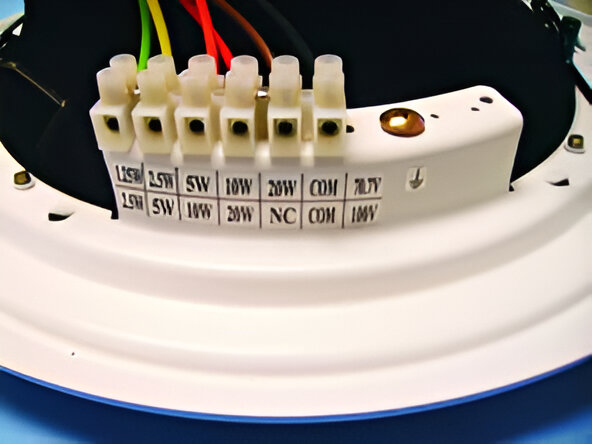
High impedance
Adding a transformer to the loudspeaker increases the impedance of the unit and makes it possible to operate multiple units in parallel. The power output of PA amplifiers is high, constant voltage (typically 100 V), and the output current is low. Therefore, with standard cross-section cables, less than 4 mm2, it is possible to connect a large number of loudspeakers over a long distance.
Example
120 W PA amplifier with 100 V line output.
- Output impedance: Z = 1002/120 = 83.33 Ω
PA speaker with 100 V / 5 W transformer
- Speaker + transformer impedance: Z = 1002/5 = 2 kΩ
How many speakers (n) can be connected using the parallel speaker connection formula?
- n = 2000 / 83.33 = 24 speakers

In PA systems, it is more common and practical to perform calculations with the power, both that of the amplifier and that of the speakers, as long as they are referred to the same output voltage (100 V, although it is possible to work at 70 V and 50 V).
The formula to be applied, in public address, is
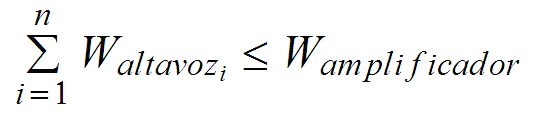
In the previous example, the calculation is simplified: n = 120 / 5 = 24
Some PA amplifiers have power outputs of 100 V, 70 V, and 50 V. Since they deliver the same power, their output impedance varies:
Z(100 V) = 1002/W
Z(70 V) = 702/W = 1/2 Z(100 V)
Z(50 V) = 502/W = 1/4 Z(100 V)
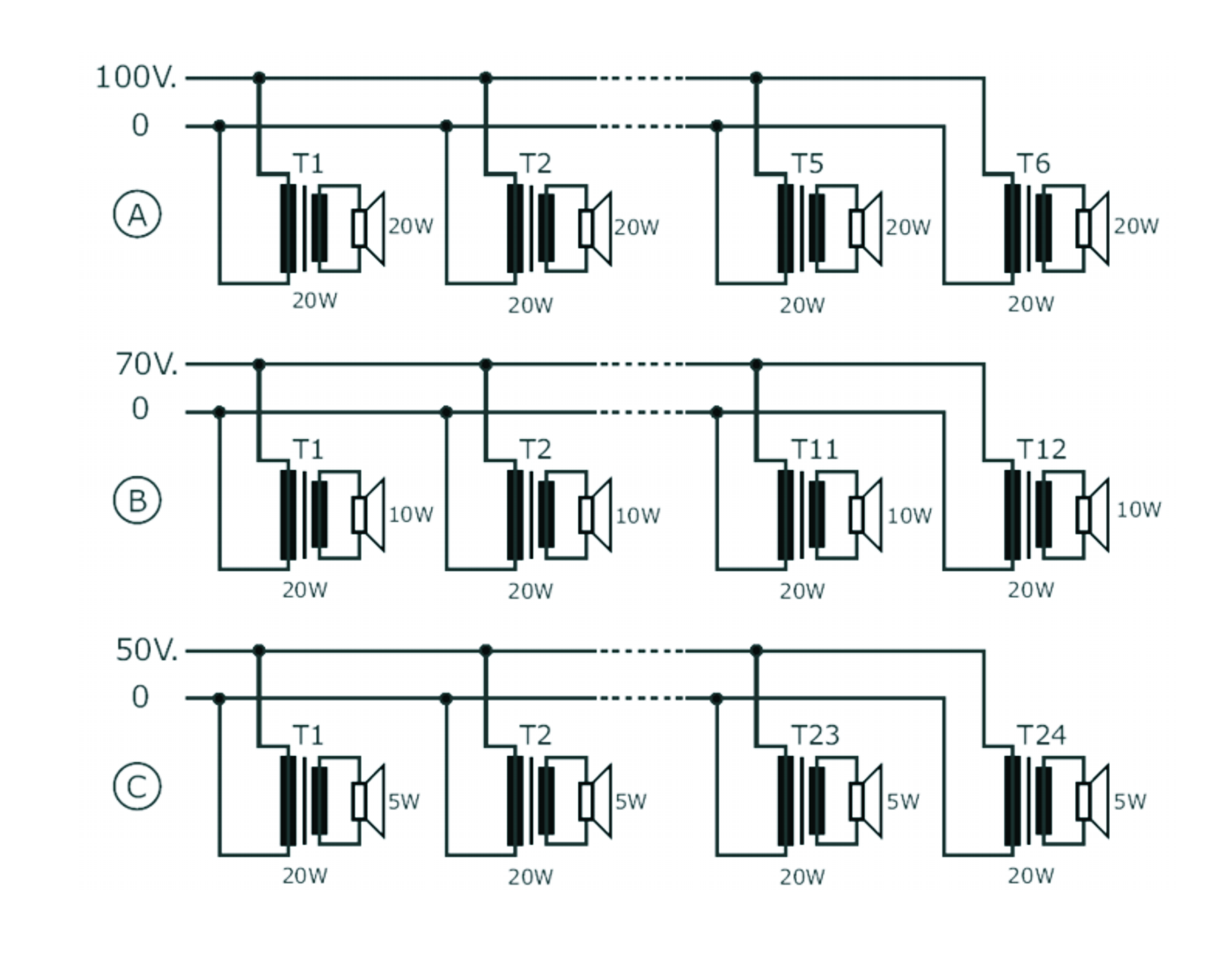
A loudspeaker with a 100 V line transformer can be connected to either the 70 V or 50 V output of an amplifier. Since their impedance is the same, they will operate at half or quarter power:
P(70 V line) = 1/2 P(100 V line)
P(50 V line) = 1/4 P(100 V line)
Exercise
Speaker with a 100 V, 20 W line transformer. What maximum power will it provide when connected to the 70 and 50 V lines of an amplifier?
SOLUTION
- Impedance: 1002 /20 = 500 Ω
- 70 V line
- P = 702 /500 = 9.8 W ~ 10 W
- 50 V line
- P = 502 /500 = 5 W