The equipment that makes up a sound system has a limited capacity to handle the audible frequency range (20–20,000 Hz). Frequency response is the behavior of the equipment at each frequency and is ultimately indicative of the fidelity of the electroacoustic system to the original signal. It is defined as the frequency range that the device is capable of capturing or reproducing with a maximum variation of ± x dB (with x = 3, 6, 10, etc.).
In general, the frequency response of the electroacoustic system will be the most restrictive of all the components that comprise it. It is important to know the recommended frequency response based on the system's application, in order to use the most appropriate equipment.
| Use | Frequency response |
| Voice | 500 ~ 4.000 Hz |
| Background music | 200 ~ 10.000 Hz |
| Music | 50 ~ 15.000 Hz |
| High fidelity | 20 ~ 20.000 Hz |
As an example, below we can see that the difference in frequency response between the two-way speaker and the horn loudspeaker is evident. The wo-way speaker has a flat response from 100 to 20,000 Hz, while the horn loudspeaker has a more irregular response from 400 to 7,000 Hz.
However, the wo-way speaker's sensitivity is approximately 90 dB SPL, and the horn loudspeaker's sensitivity is approximately 110 dB SPL.
Depending on the needs of the PA system, we will use one model or the other, or a combination of the two.
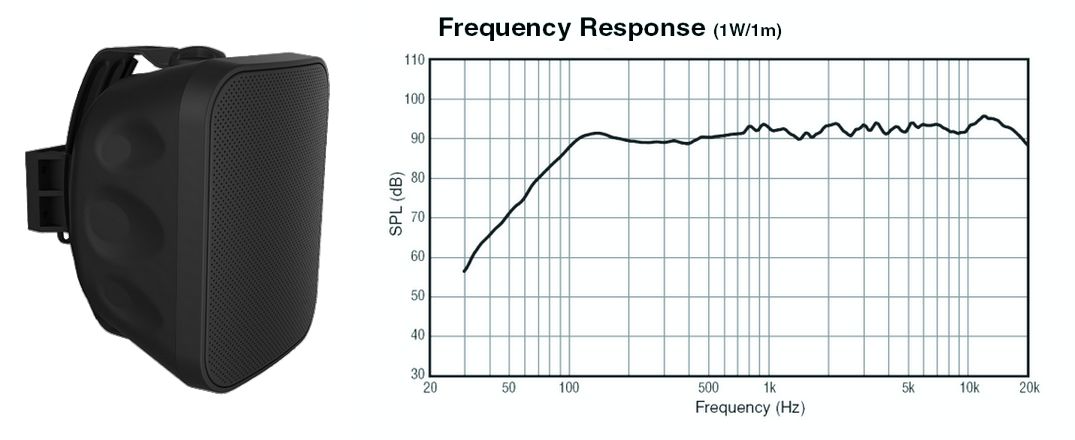
Frequency response of a two-way speaker
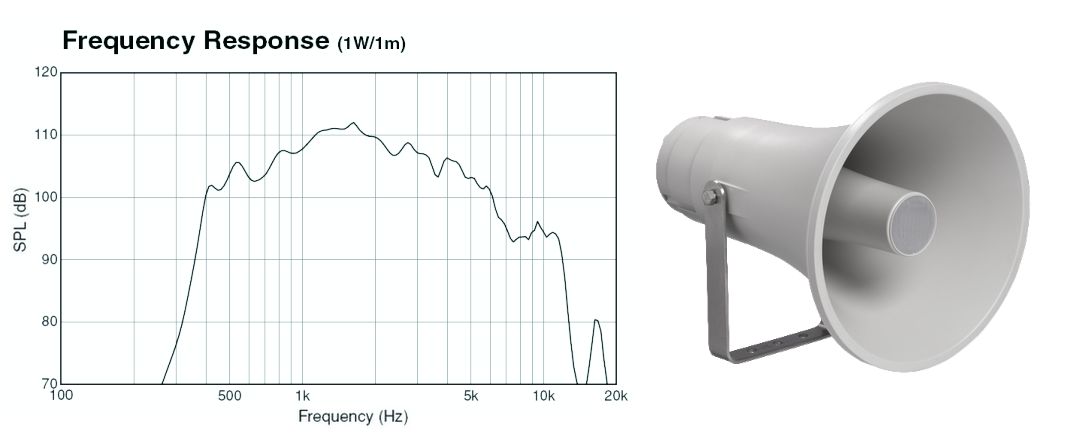
Frequency response of a horn speaker