ACOUSTIC COLUMNS
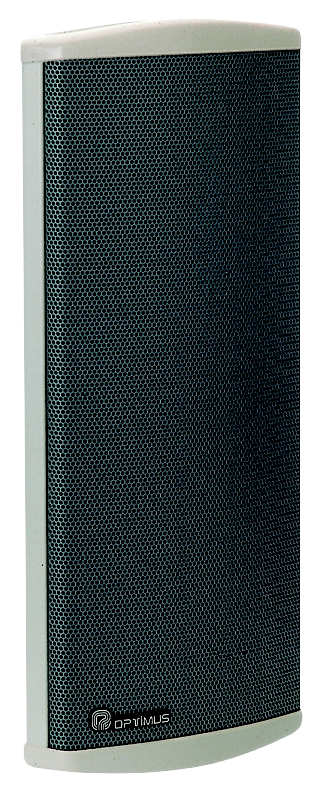
Acoustic columns incorporate several identical speakers mounted in a line. The vertical coverage angle is reduced, while the horizontal coverage angle is widened. In reverberant venues (e.g., churches), acoustic column direct the acoustic beam toward the auditorium, avoiding reflections and echoes that reduce intelligibility.
- Acoustic columns diffuse the sound layer at the listener's height and do not project it toward the ceiling.
- The sound pressure of these speakers is quite high (over 100 dB), and the frequency response is adequate for music and speech.
- The mounting height, angle of inclination, and orientation must be calculated so that the axis of the acoustic beam passes at the listening height (between 1.5 and 1.6 m) of the furthest listeners.
- The reach of a speaker depends on its physical height. A distance between 10 and 20 times their height is considered (for example, the reach of a 0.7 m tall column will be between 7 and 14 meters).
- They are usually distributed along the two side walls of the auditorium (churches, assembly halls, conference rooms, etc.). They are also suitable for railway or bus platforms.
Calculator - Conference Rooms
Conference rooms are typically low-reverberation spaces, where the highest possible intelligibility is important. Ambient noise is low, with values approaching 50 dB.
Acoustic columns are installed on the long walls at a height between 2 and 3 meters. This height and the column's inclination are calculated so that the axis of the acoustic beam passes at the listening height (between 1.5 and 1.7 m) of the furthest listeners.
For these spaces, the highest-quality models are recommended to achieve the correct frequency response for both speech and background music.
Help articles
Attenuation | Noise | Acoustic columns | Catalogue