The propagation of a sound wave is affected by the nature of the medium through which it is transmitted. Sound, like light, forms a spherical wave in still air. As the sound moves away from its source, its energy is spread over larger volumes and is therefore attenuated. The theory applied considers a point sound source that generates a spherical surface wave whose sound pressure level is inversely proportional to the square of the distance.
To calculate the attenuation of sound pressure between a point at distance Da and another at distance Db is:
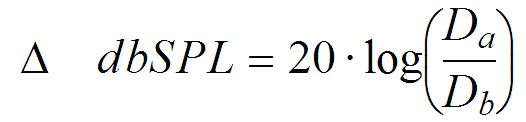
Each time the distance is doubled, the sound pressure decreases by 6 dB SPL.
Ejercicio
The following drawing shows the SPL achieved with a 109 dB sensitivity exponential loudspeaker (1 W, 1 m, 1 kHz):
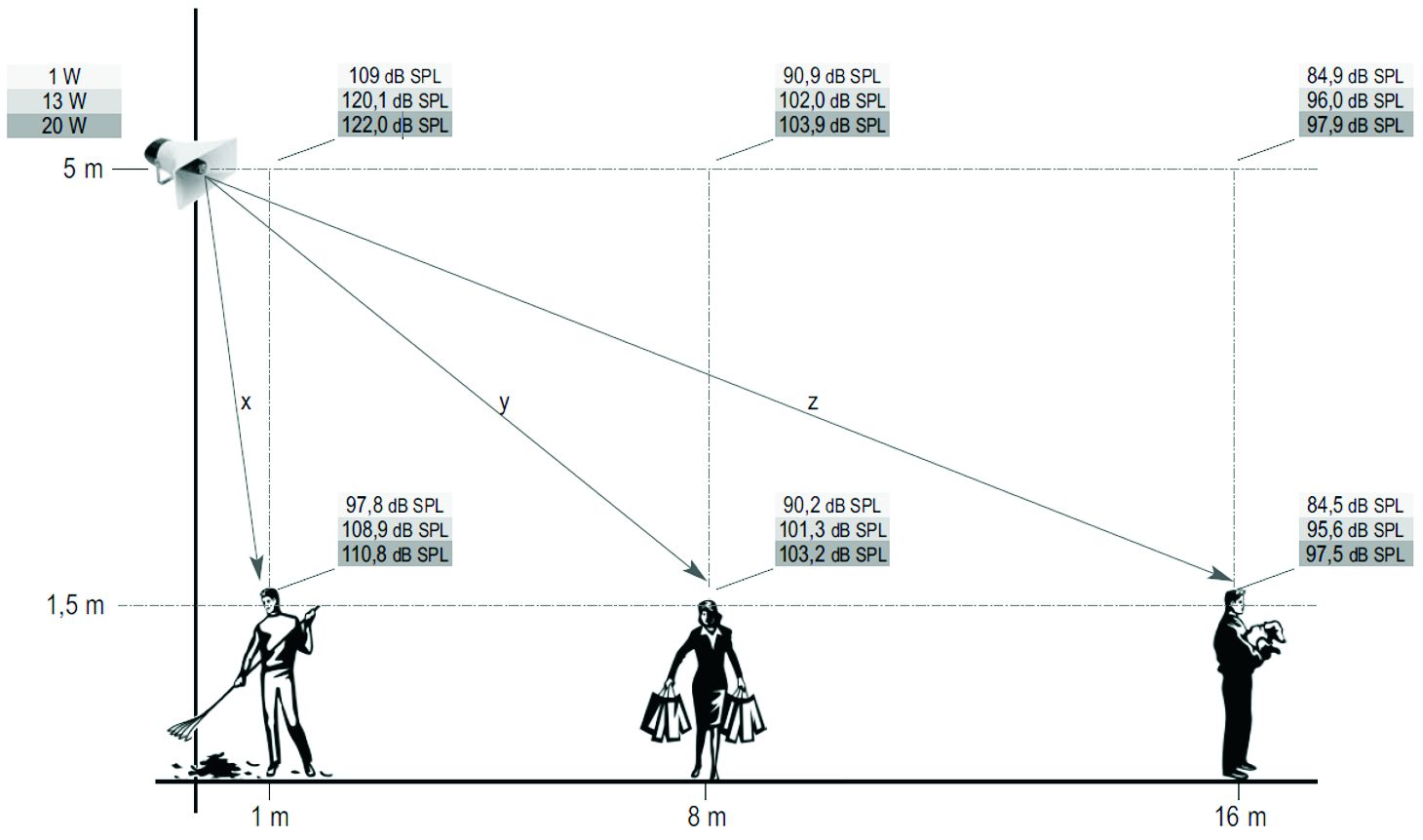
If the noise level is about 70 dB SPL, for example, all three will hear it well with 1 W applied to the speaker. If the noise is higher, a higher power output will be necessary, or listeners farther away will lose intelligibility.
In addition to what was discussed above regarding attenuation and applied power, we can introduce another topic: the uniformity of acoustic coverage. We observe that at the height of a person's ear, there is a difference of 13.3 dB SPL from the closest to the farthest speaker. It is very difficult for a single speaker to cover large distances evenly. A difference of 13.3 dB is excessive; good design ensures that the variation in acoustic pressure is smaller (1 to 5 dB SPL). To achieve this, speakers are typically distributed, grouped, oriented to take advantage of their directivity, different power levels are applied, specific formats are used, etc.
In installations with multiple speakers distributed throughout the system, calculating the resulting SPL becomes quite complicated. It depends on whether the distance between them is less than a wavelength and the emitted signal is the same in phase and amplitude. If so, the signals are coherent, and the increase when doubling the power (let's assume two stacked subwoofers) is 6 dB for a certain frequency range (remember that the wavelength of an audio signal ranges from 1.7 cm to 17 m). If not, we speak of non-coherent signals, and they add linearly.
Exercise
At a certain point in the room, signals are received from three speakers: one at 94 dB, one at 90 dB, and one at 92 dB. What sound pressure does a listener at that point receive?
Solution
To convert from dB SPL to W
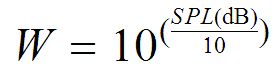
Therefore