The definition of acoustic pressure is the force applied per unit area, superimposed on atmospheric pressure. Its unit of measurement is the Pascal (Pa). We must bear in mind that the physical phenomenon is the same as that of atmospheric pressure, although in one case the values vary very rapidly, and in another case the values vary very high and constant, or vary very slowly.
Static atmospheric pressure varies very slowly around the following value:
At sea level 1,013 mbar = 101,325 pascals (Pa) = 1,031 hPa
If we constantly measure the absolute value of the pressure at a given place and time (instantaneous pressure) we obtain the acoustic pressure as follows:
Sound pressure = Instantaneous pressure – Static atmospheric pressure
Therefore, we see that acoustic pressure is the small variations around the fixed value of static atmospheric pressure.
Decibels
The human ear detects sounds from 0.00002 Pa (hearing threshold) to 65 Pa (pain threshold). To conveniently manage this wide range of 6 orders of magnitude, we use decibels.
Furthermore, the nature of human hearing is very close to a logarithmic scale, where small variations at low values are very noticeable and large variations at high levels are much less noticeable.
As with any logarithmic scale, we start from a reference value, in this case the hearing threshold, of 0.00002 Pa = 20 μPa.
| Value in Pa | Value in dB SPL | |
| hearing threshold | 0,00002 Pa | 0 dB SPL |
| conversation at 1 m | 0,02 Pa | 60 dB SPL |
| heavy traffic 20 m away | 0,25 Pa | 82 dB SPL |
| jackhammer at 1 m | 30 Pa | 123 dB SPL |
| pain threshold | 65 Pa | 130 dB SPL |
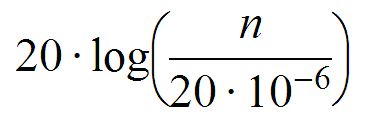
The dB SPL values in the table are obtained from the formula
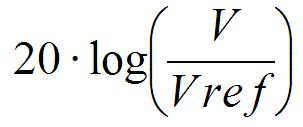
The dB also appears when referring to the voltage of audio signals. Depending on the reference used, we speak of dBmV (Vref = 1 mV), dBV (Vref = 1 V), or dBu (Vref = 775 mV).
The formula, in any case, is the same
If we handle power, the formula changes, since
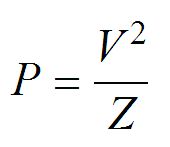
And normally what we are interested in is the increase in sound pressure when increasing the electrical power delivered to a loudspeaker. The manufacturer provides as characteristic data of the loudspeaker its “sensitivity”, S, defined as the dB SPL it provides at 1 m distance when a 1 kHz signal and 1 W of power is applied to its input.
To know the increase in sound pressure when applying a power P we use the following formula

Every time the power delivered to a speaker is doubled, the sound pressure increases by 3 dB.
Exercise
Speaker with a sensitivity of 90 dB SPL 1 W, 1 m, 1 kHz. A power of 30 W is delivered. What is the sound pressure level at 1 m?. Solution: 90 + 10.log30 = 104,8 dB SPL