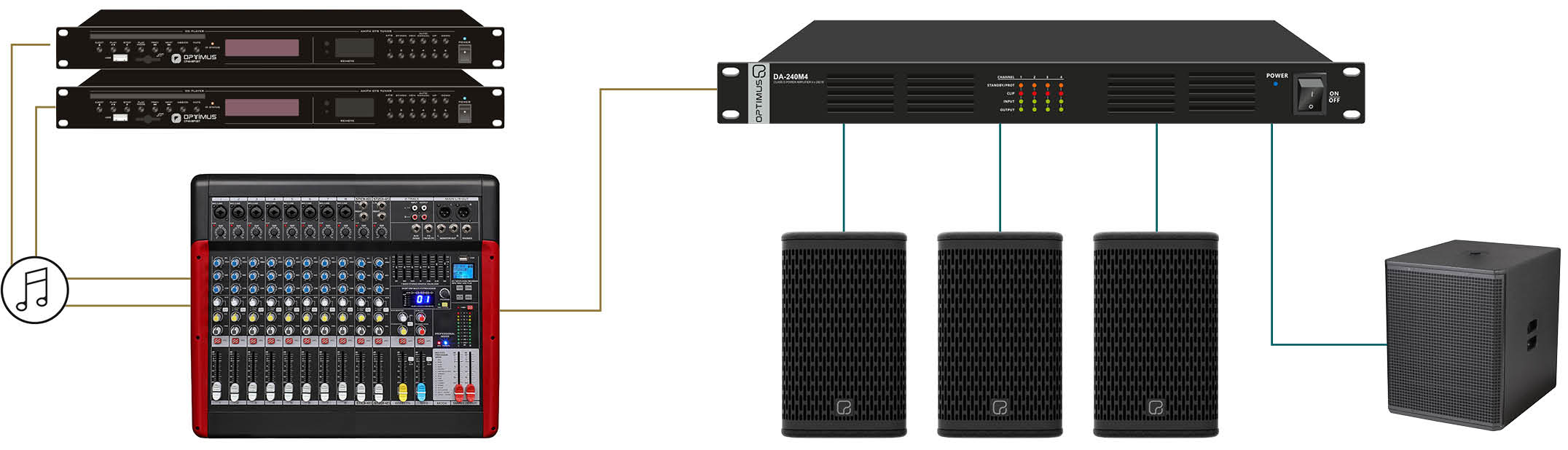
Unlike background music distribution, when it comes to amplifying music in music bars or gyms, for example, factors such as the following become relevant:
- At high volumes, the quality of the music is more easily detected. The frequency response should be wider and flatter, and distortion should be lower.
- In many cases, depending on the application and the client, the low-frequency response should be below 60 Hz (with one or two subwoofers), and the high-frequency response should be above 16 kHz.
- The amplifier (power) and the speakers (sensitivity and power) must be suitable for reproducing, without distortion, a musical signal that can be five or ten times higher than that distributed in the case of background music.