
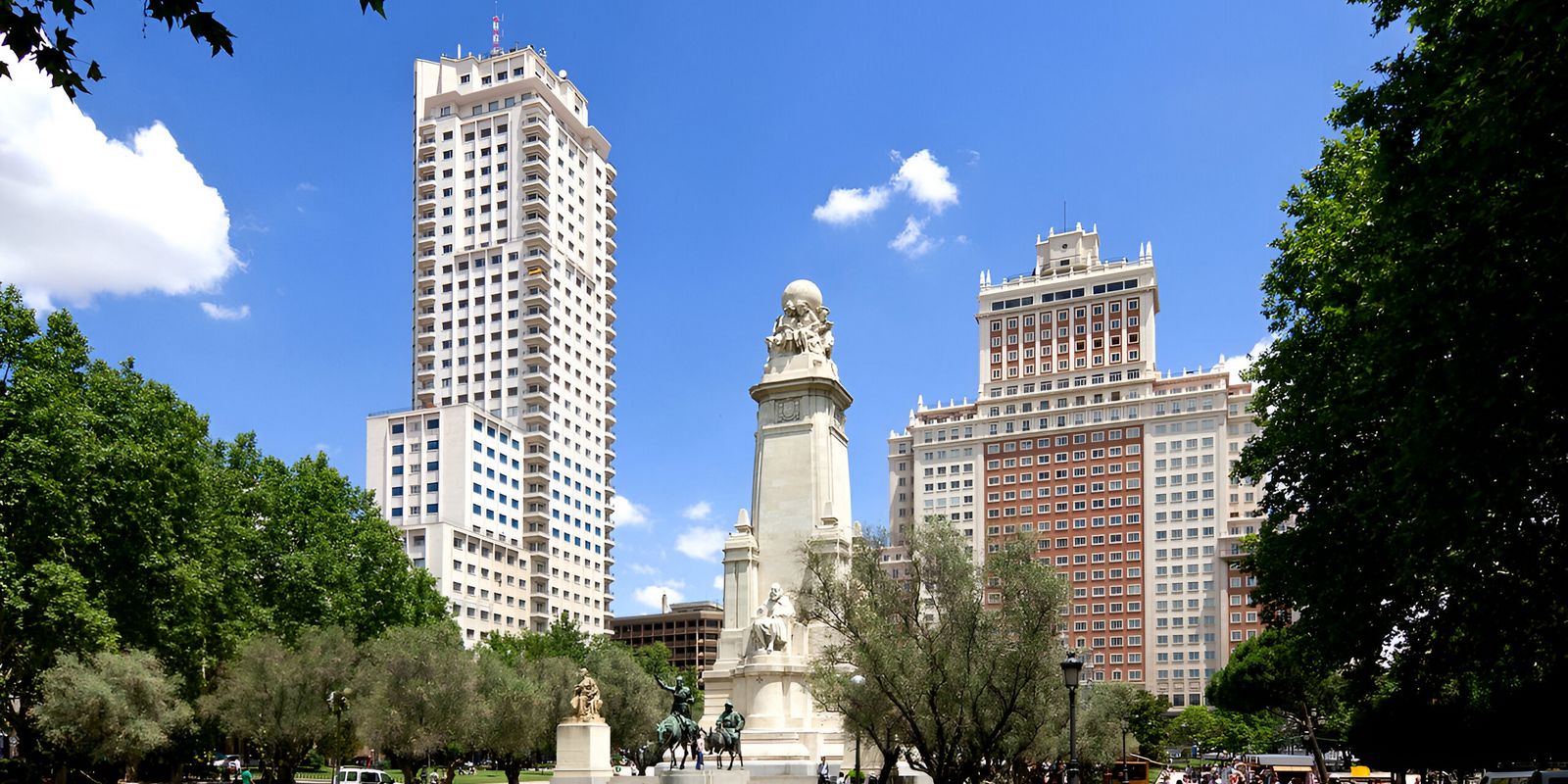
The Torre de Madrid is one of the most iconic skyscrapers in the Spanish capital. Located in Plaza de España, between Princesa Street and Gran Vía, this imposing 142-meter-high building was designed by architects Julián and José María Otamendi Machimbarrena, who also created the nearby Edificio España. Construction took place between 1954 and 1960, and for several years it was the tallest concrete building in the world, as well as the tallest in Spain until the opening of Torrespaña in 1982.
With its 34 floors, the tower was conceived as a symbol of modernity and progress in post-war Spain. Its functionalist design, inspired by New York’s Empire State Building, features a reinforced concrete structure, exposed brick façade and vertical lines that emphasize its height. At the time, it housed offices, luxury apartments, commercial spaces and even a cinema. Today, after several renovations, it combines residential use on the upper floors with a five-star hotel occupying the first nine floors, offering spectacular views of Madrid’s skyline.
The tower has appeared in films, documentaries and musical works, and together with the Edificio España forms a protected architectural ensemble under the Madrid City Council. Its strategic location in the heart of the city makes it an urban and cultural landmark, visible from iconic points such as the Royal Palace and Casa de Campo.
Inside the building is a five-star hotel, equipped with a professional public address system featuring more than 300 loudspeakers distributed throughout the complex, connected via a dSOUND digital audio system. Each room includes an amplifier model 2653-AS, which distributes television audio to speakers installed in the bathroom and living area, while also linking to the building’s general PA system to ensure the broadcast of emergency messages or general information.
The hotel also features several intercom systems strategically located in refuge areas, main entrances, and technical zones such as the restaurant kitchen, ensuring fast and effective communication between staff and security services. The entire system is designed to meet the regulatory and operational requirements of high-demand facilities, ensuring reliability, coverage, and sound quality throughout all spaces.