Sound wave propagation rarely occurs in free space and with a completely calm atmosphere. Physical obstacles and atmospheric agents (wind, rain, humidity) produce alterations in the sound path and energy transmission, and they do not do so equally for all frequencies.
Sound reflection
When a sound wave hits a surface, part of it is reflected, part is refracted and/or absorbed, and part is transmitted. Sound reflects well on hard, rigid surfaces, but poorly on porous, soft, and deformable surfaces. The materials used in the walls, ceiling, and floor of the rooms to be soundproofed greatly influence the final solution adopted. Glass, marble, or metal strongly reflect sound and reduce the intelligibility of the transmitted message. Wood, fabric, or a false cork ceiling absorbs sound and facilitates intelligibility. People, furniture, and seating also have an influence and must be taken into account when calculating the soundproofing.

The phenomenon of reflection can be observed in the diagram:
- sound front
- reflected wave
- refracted wave
- absorbed wave
- transmitted wave
Sound refraction
In the atmosphere, temperature variations can alter the path of sound. Gradients or variations in height cause the wavefront to shift toward the cold zone.

Public address systems for outdoor sound, such as those for general announcements in villages, with loudspeakers located in the church bell tower, must take into account, above all, daytime refraction; the deviation of the wave towards the sky can cause part of the village to miss the broadcast message.
Sound diffraction
The behaviour of a sound wave when it encounters an object depends on its size, but in general, it is distorted and deflected behind the object. If the obstacle is small compared to the wavelength of the sound, the sound is transmitted by diffraction, but if it is large compared to the wavelength of the sound, "shadow" areas appear behind the obstacle.

Since a sound is composed of multiple frequencies, the result is that in the shadow area, a range of frequencies (the highest ones) are attenuated. Depending on the size of the object, they will be affected by a higher or lower frequency.
The phenomenon of diffraction allows us to hear the message with a clipping of the highest frequencies.
Effect of wind
Wind speeds are generally higher at higher altitudes. If the sound wave is travelling with the wind, it is deflected toward the ground, and if it is travelling against the wind, it is deflected toward the sky.
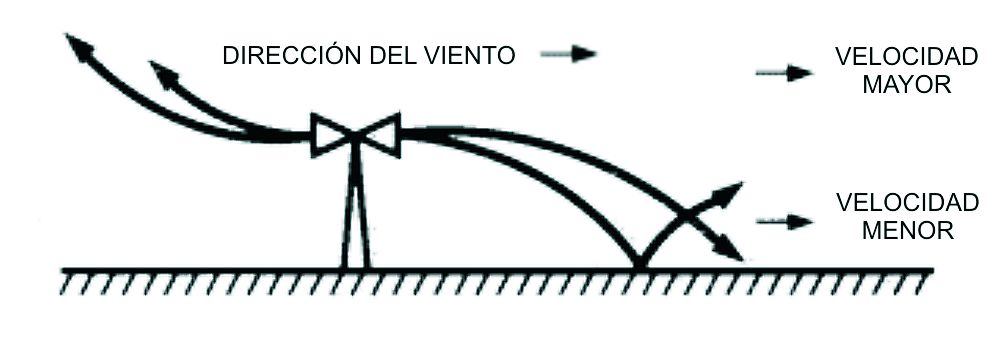
The combination of the effects seen so far recommends, in outdoor sound installations, focusing the speakers towards the ground and thinking about short distances, as long distances are highly conditioned by the air, temperature and obstacles.