One of the most important parameters of sound is its frequency (f), which is defined as the inverse of the period, is measured in hertz (Hz) and is the number of vibrations that occur in one second.

Frequency tells us whether a sound is low-pitched (few vibrations) or high-pitched (many vibrations). The psychoacoustic parameter linked to frequency is pitch. In many audio systems, it is possible to vary the amount of bass and treble using the tone control.
 bass sound
 treble sound
A sound is formed by the superposition of many frequencies. In mathematical terms, an acoustic signal is a sum of sinusoidal signals (Fourier equation), and everything that applies to a sinusoidal signal also applies to an audio signal. Except for the pure note produced by a tuning fork, or an artificially generated wave, virtually all sounds are composed of an infinite number of waves. The one with the greatest amplitude is the most important and is called the fundamental frequency. The remaining superimposed frequencies are harmonics, multiples of the fundamental, and determine the timbre of the sound, allowing us to differentiate, for example, a violin from a piano playing the same note, or two singers performing the same song.
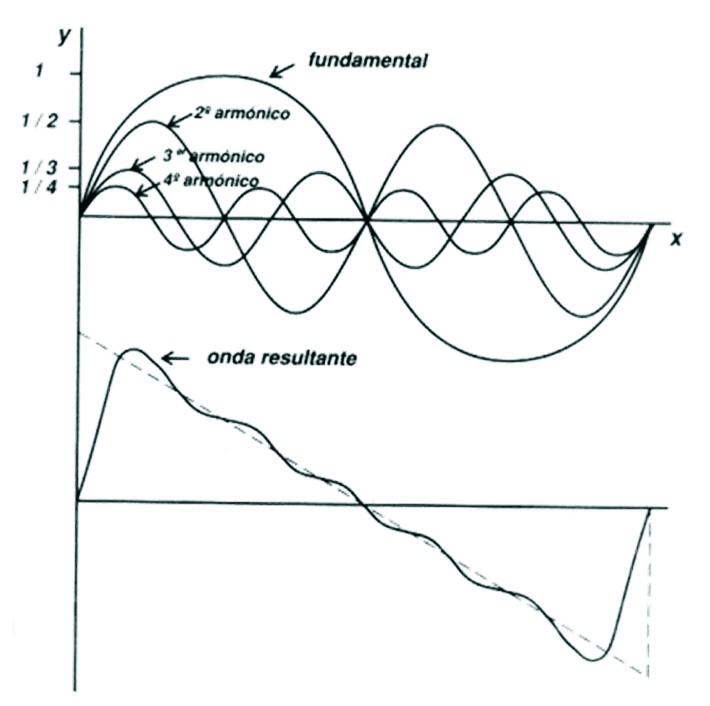 resulting wave
fundamental + three harmonics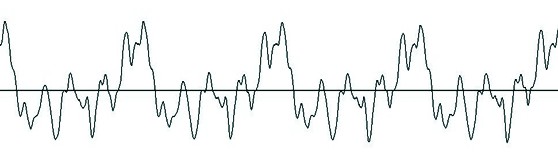 periodicity of an audio wave
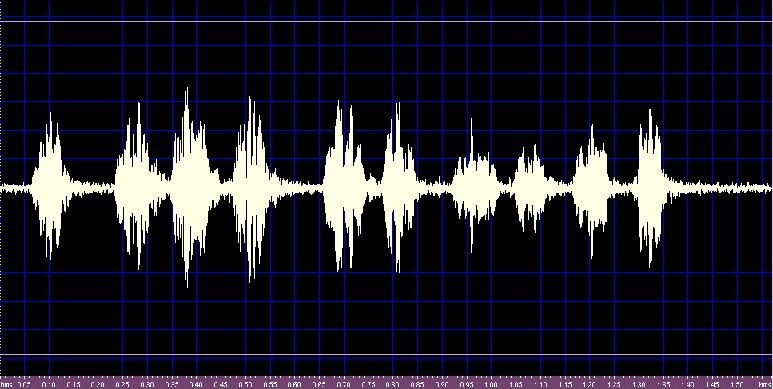 real audio wave
Below 20 Hz, humans do not perceive sounds as continuous, and above 20,000 Hz, our hearing does not respond to stimuli. By analogy with sound equipment, we speak of a human frequency response of 20 to 20,000 Hz.
In PA systems, intelligibility is important, and we know that the ear is most sensitive to the frequency band between 700 and 6,000 Hz. Many PA systems focus on this frequency band, with specific loudspeakers or filters that eliminate other frequencies.
In addition to the audible frequency and sound pressure ranges, which are physically measurable data, another range is used: loudness (measured in phons). It is a psychoacoustic scale, as the ear is more sensitive to certain frequencies and acoustic pressures. Phones and dB SPL, by definition, are the same at 1 kHz. Based on this convention, the Robinson Dadson curves (ISO standard) or isophonic curves show the dB SPL levels necessary to produce the same phones. For example, a sound of 60 dB SPL at 1 kHz produces 60 phones, the same as 80 dB SPL at 50 Hz, and the same as 50 dB at 3 kHz.
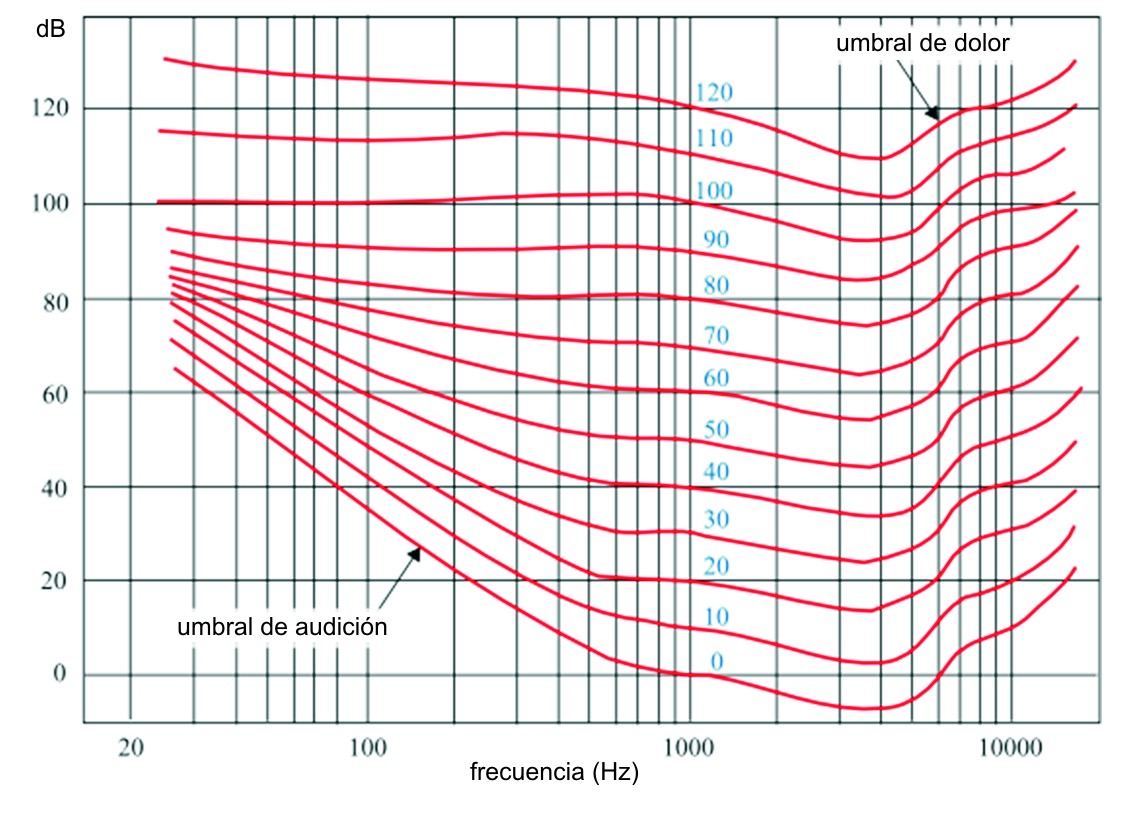
The graphs show an easily audible range between 3 and 4 kHz, while maintaining the same intensity at low frequencies requires a significant increase in sound pressure.
Furthermore, the ear's response is not the same if the sound pressure is lowered (i.e., if the volume is lowered); it is less linear. The loudness filter on stereo systems compensates for this effect.