A sound wave, or sound vibration, is an oscillation of the particles of elastic, dense bodies around their resting position. Air, water, and a metal pipe are all elastic, dense bodies, and they transmit sound according to their properties.
For example, sound travels much faster in water than in air, and in a vacuum, it doesn't travel at all.
A sound wave is characterised by a series of characteristic parameters, each associated with a physical dimension and an auditory sensation.

Observing the waveform of a pure sound, for example, produced by a tuning fork and captured by an oscilloscope, we can define:
Period (T)
Time interval required to complete a repetitive cycle, measured in seconds (s).
Amplitude
A value that indicates whether a sound is loud or soft. It is usually measured in volts (V), referring to its electrical conversion, or in dB SPL (sound pressure level) if we refer to its sound pressure. It is also called sound intensity and sometimes erroneously called loudness, a psychoacoustic parameter that corresponds to the subjective assessment of amplitude.
Phase difference (θ)
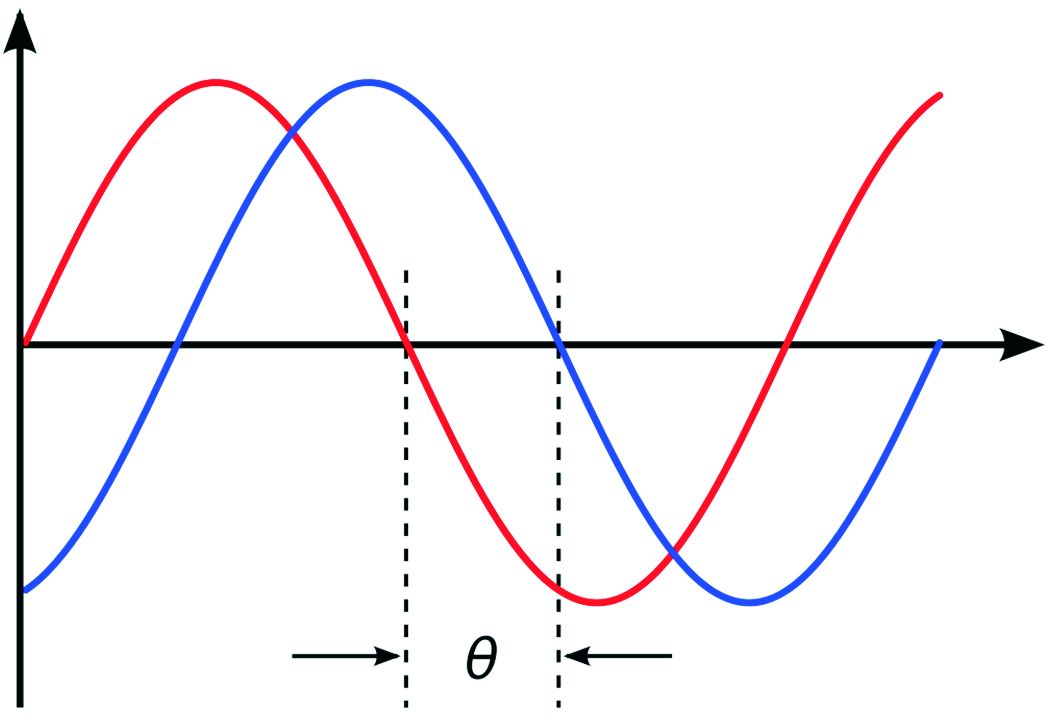
Difference, in seconds (s), between two sound waves at a given point in their cycles.