Intelligibility depends on several factors. It is usually worse the more reflections are perceived, therefore better in the direct field than in the reflected field, and finally worse in the diffuse field. The interpretation that the brain makes when it receives the same sound several times is different depending on the time difference, an effect described by Helmut Haas in 1949 and therefore called the Haas effect:
- If the difference is less than 5 ms, the brain localises the sound based on the direction of the first stimulus, even if the others come from diametrically opposite directions.
- If the delay is between 5 and 50 ms, the listener hears a single sound, but it's twice as loud, and locates the source halfway between the other sounds.
- If the reflected sound takes longer than 50 ms, the brain distinguishes between the origin and the time delay. If it's a single reflection, it's called an echo.
In 50 ms, given that the speed of sound propagation in air is about 340 m/s, the distance a wave travels is about 17 m.

In sound transmission, one of the factors that most influences the loss of intelligibility is reverberation, an effect that occurs when receiving reflected waves of sufficient intensity and with a delay greater than 20 ms.
This is an easily recognisable effect, for example, in a large cathedral, with its large dimensions, high ceilings, architecture and construction materials... the reflected waves are barely attenuated and travel great distances, reaching the listener with long delays.
Reverberation is so important that it is quantified to characterise the room to be soundproofed. Reverberation time (TR or T60) is defined as the time it takes for a sound to attenuate to 60 dB SPL. It depends on several parameters, including the volume of the room, the surface area of the walls, and the construction materials. One of the most commonly used formulas is Sabine's:
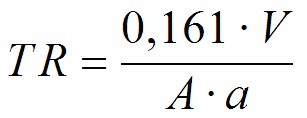
where V is the volume of the room in m3, A is the total surface area of the walls, floor and ceiling in m2, and a is the average absorption coefficient of the room. There are more precise formulas, and, in general, sophisticated computer programs or measuring equipment are used, as there are many architectural elements in a room that complicate the calculation.
To simplify the measurement equipment, the time to attenuate 20 or 30 dB SPL is measured and then multiplied by 3 or 2.
The reverberation time is longer when the absorption coefficient of the walls is lower. A room with reflective surfaces (glass, marble) and no acoustic treatment (wood paneling, curtains, carpets, etc.) is defined as a bright or live room. A room with excessively absorbent materials is defined as a dead room. Both extremes are bad. In general, it can be said that short T60s favor voice intelligibility, and long T60s enrich the music.
Depending on what you want from a room, there is a table of recommended T60 values:
| Use of the room | T60 |
| Radio booth | 0.2 ~ 0.4 |
| Voice room | 0.7 ~ 1.0 |
| Theatre | 0.9 |
| Cinema | 1.0 ~ 1.2 |
| Opera | 1.2 ~ 1.5 |
| Chamber Music | 1.3 ~ 1.7 |
| Symphonic Music | 1.6 ~ 2.0 |
| Choral and Sacred Music | 2,0 ~ 4,0 |
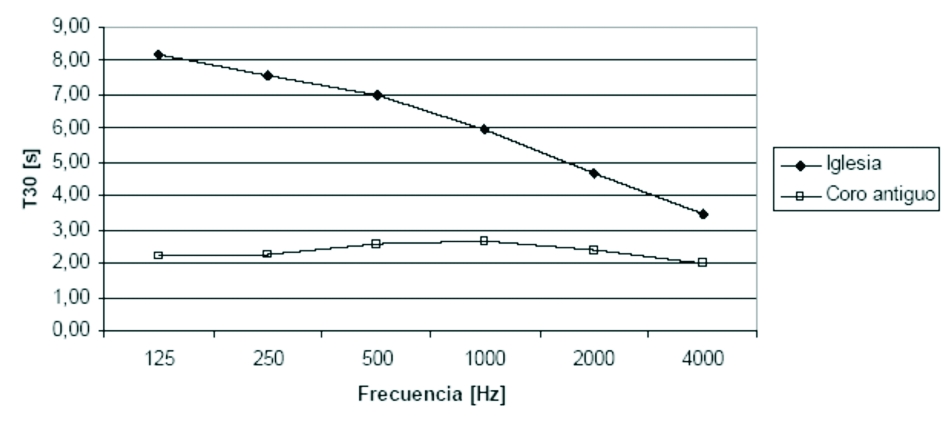
The graph is a real case of a monastery. We observe that the old choir is set up for sacred music, but not the church, with very high reverberation up to approximately 3 kHz.
A complete electroacoustic treatment will be necessary to reduce the reverberation time.
Ultimately, intelligibility depends on the acoustic conditions of the room (reverberation), the ambient noise, and the electroacoustic equipment. Various systems are used to measure it. The most commonly used are:
% Alcons: The loss of consonant articulation is measured. If it exceeds 15%, it renders the message unintelligible. Recognition tests are carried out on 100 syllables without special meaning, transmitted for recognition to a certain number of people who statistically represent the target audience of the message. The percentage of articulation is calculated as the ratio of those recognised to those transmitted. It must be greater than 85%. Below 65%, the effort to understand the message is high.
STI / RASTI: Calculation method based on emitting a test signal, which is measured by a microphone located in the room. STI stands for Speech Transmission Index, and RASTI is the simplified calculation commonly used, Rapid Speech Transmission Index. As it is a mathematical calculation, whether based on actual measurements or acoustic simulations, it is the most common.
The following table indicates the ranges used and the relationship between RASTI and %ALCONS. In PA systems, sound reinforcement systems must guarantee a RASTI of at least 0.45.
| RASTI | %ALcons | |
| Excellent | 0,75 ~ 1,0 | 0 ~ 3% |
| Good | 0,6 ~ 0,75 | 3 ~ 7 % |
| Regular | 0,45 ~ 0,6 | 7 ~ 15 % |
| Poor | 0,3 ~ 0,45 | 15 ~ 33 % |
| Ininteligible | 0,0 ~ 0,3 | 33 ~ 100 % |
Example
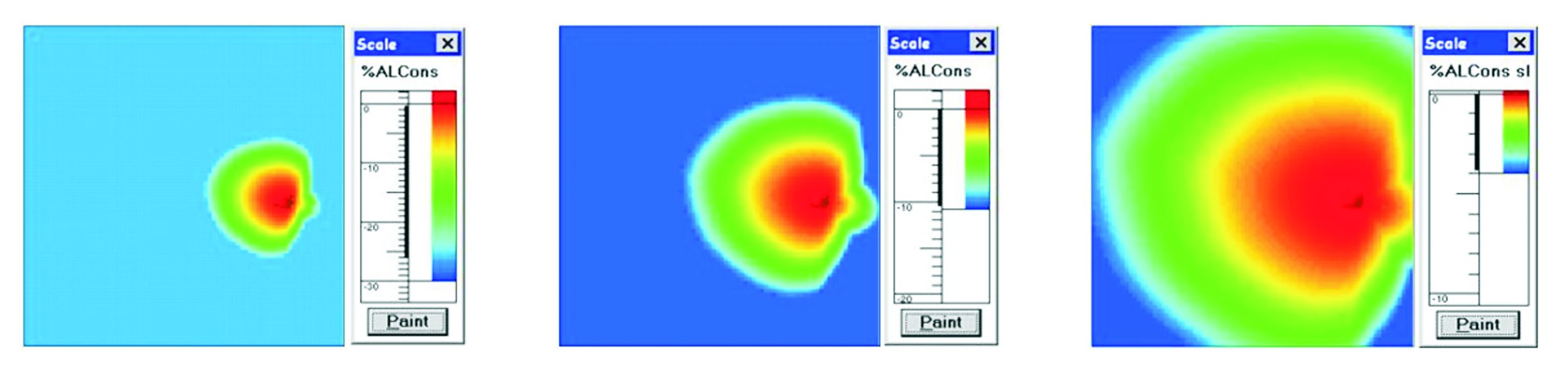
The following diagrams show %ALcons of a classroom, first under construction, then completed and finally acoustically treated.