
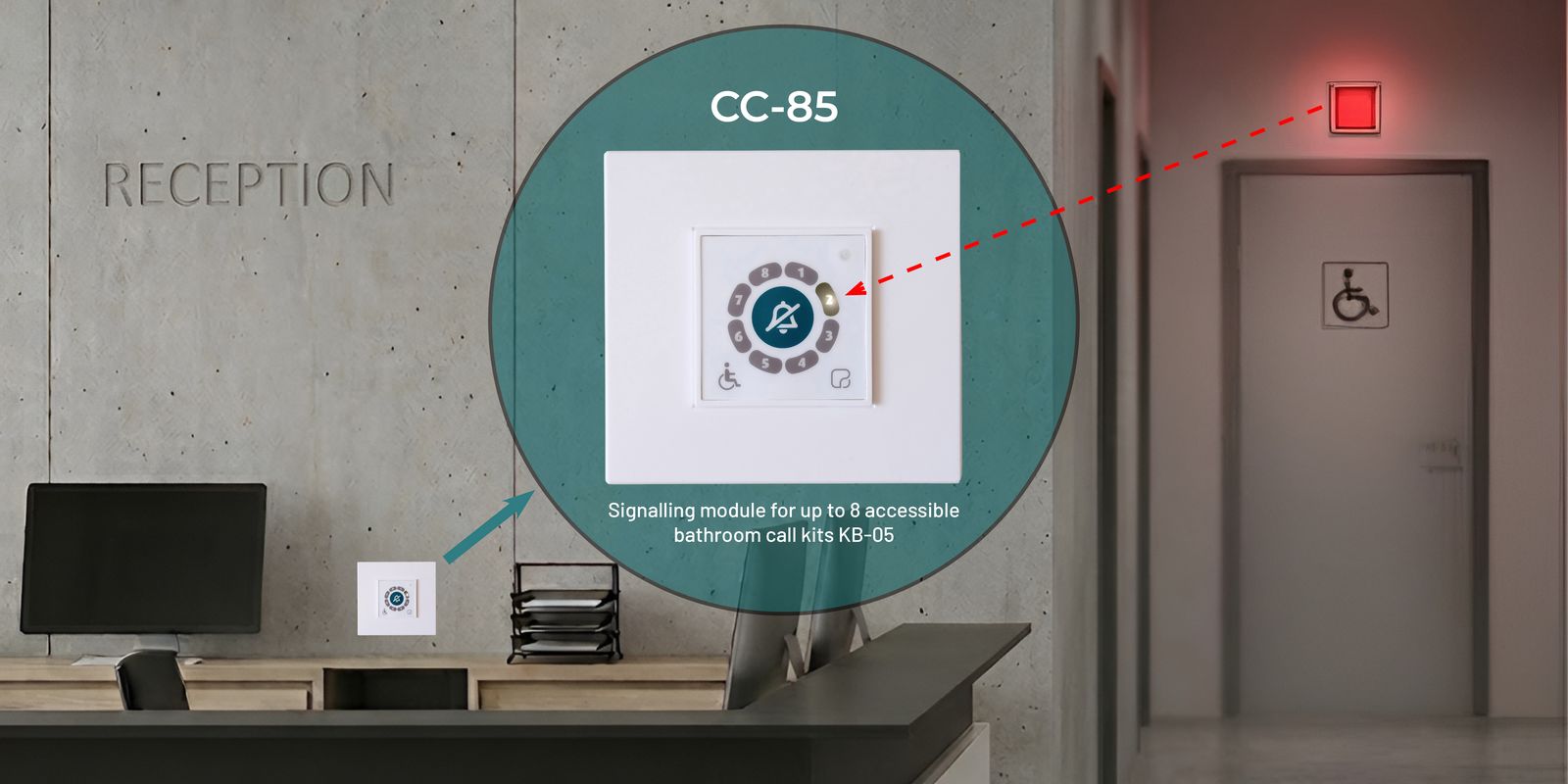
In the design of public, commercial, or public residential buildings, ensuring the accessibility and safety of all users is an absolute priority and a legal requirement. The Spanish Technical Building Code (Código Técnico de la Edificación - CTE DB SU - SUA3) stipulates that accessible toilets and changing rooms must feature a call system that allows users to request assistance and effectively know that their warning has been received. While the KB-05 kit resolves this need autonomously at a local level in each toilet or changing room, the CC-85 indicator enhances security by unifying the management of multiple kits into a single control device.
Regulatory Compliance
The combination of the KB-05 kit and the CC-85 indicator provides a comprehensive, joint security solution fully compliant with current regulations (including the ISO 21542 standard for pull-cord mechanisms). When a user activates the emergency call in the toilet using the pull-cord, the local KB-05 kit emits an acoustic and luminous signal in a high-traffic area and activates a witness LED to confirm to the user that the alarm is active.
Simultaneously, the CC-85 receives the notification at the control station (such as a reception desk, security desk, or nursing room) immediately. In this way, facility staff do not rely solely on hearing the local warning in the corridor, but can instantly visualize the alert in a centralized location.
Clear, Intuitive, and Centralized Monitoring
The design of the CC-85 stands out for its functionality and intelligibility. The device features eight independent LED segments that light up to identify clearly, and at a glance, the exact origin of the call among the different connected cabins.
The indicator incorporates a practical MUTE button to silence the acoustic warning at the control station while staff attend to the emergency, keeping the luminous indication active. In compliance with safety protocols, the definitive cancellation of the alarm cannot be performed remotely: it is mandatory to physically go to the affected toilet or changing room and press the cancellation button, thus ensuring that the user receives the required face-to-face attention.
Versatile installation and elegant design
Designed for both new construction projects and retrofits or refurbishments, the CC-85 has been developed for easy installation in a standard universal box. Its compact size and white finish (including frame) allow it to blend aesthetically into any work or control environment without altering the space's decor.
As extension options for the installation, the system features the following accessories:
- RF-KB perimeter cord: allows the call to be activated from the floor and from any point around the perimeter, without depending exclusively on the vertical axis of the mechanism's pull-cord.
- KB-CRT information sign: a signaling element that informs the user about the existence of the call point and provides instructions for its proper use.
With the launch of the CC-85, OPTIMUS reaffirms its commitment to creating more accessible, secure, and easy-to-manage environments, providing installers and engineering firms with a robust, cost-effective, and highly reliable solution for monitoring accessible toilet areas.
Need greater scale or integration? The KB-10F alternative
For projects that go beyond managing one or a few accessible bathrooms, the KB-10F kit offers maximum versatility thanks to its integration with our SMC system. With this kit, it is possible to achieve::
- Unlimited control: Allows massive supervision from dozens to hundreds of accessible bathrooms through the SMC system control units (such as the CC-119F).
- Convergence of services: Centralizes within the same infrastructure the assistance calls from the restrooms along with the intercom systems for refuge areas, access control, or hospital systems.
- Design and identification: Its aesthetics are aligned with the hospital range, incorporating high-visibility colors and pictograms. It is the ideal solution for hospitals, clinics, nursing homes, or commercial complexes that require a global and unified security management.