The proposed speaker layout must meet a series of essential acoustic criteria for any sound system. Whether the calculations are performed manually or with the help of a simulator, real data from the speaker model must be used, and the speaker model must be selected and replaced if the results are inadequate.
Regarding sound pressure, this must be uniform throughout the venue, with a maximum variation established according to the use of the sound system.
The signal-to-noise ratio must be at least 15 dB to ensure intelligibility. Depending on the venue and its use, the use of noise probes must be considered. These probes measure ambient noise and allow automatic amplification adjustment to achieve this 15 dB under any circumstances.
The reverberation time (TR) or T60 is the time it takes for a sound level to decrease by 60 dB from its initial value. Acoustic simulation programs easily calculate it once all the parameters have been entered.
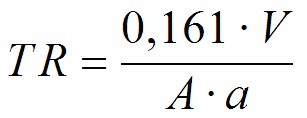
| Use of the room | V (103 m3 ) | T60 |
| Radio booth | < 1 | 0,2 ~ 0,4 |
| Vocal room | < 4 | 0,7 ~ 1,0 |
| Theater | 5 ~ 20 | 0,9 |
| Cinema | 0,3 ~ 10 | 1,0 ~ 1,2 |
| Opera | 10 ~ 25 | 1,2 ~ 1,5 |
| Chamber music | 0,3 ~ 11 | 1,3 ~ 1,7 |
| Symphonic music | 2 ~ 20 | 1,6 ~ 2,0 |
| Choral and sacred music | 1 ~ 25 | 2,0 ~ 4,0 |
Acoustic simulation programs, with their extensive computing power, can calculate parameters that would be virtually impossible to calculate manually.
To calculate the critical distance, the point where the direct and reverberant sounds are at the same level, the following formula is commonly used:
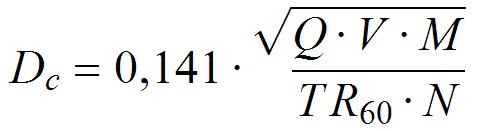
Intelligibility is also calculated by measuring the loss of articulation of consonants in % ALcons, with the formula:

In both formulas, the variables used are:
- D: distance from the speaker to the listener
- Q: speaker directivity factor (a function of frequency and radiation angle)
- V: room volume
- M: modifier based on the absorption coefficient of the analysis point (M usually = 1)
- N: number of speakers that have a direct impact on the analysis point.